Wearable Computing Project (3/10)
Posted by Wesley on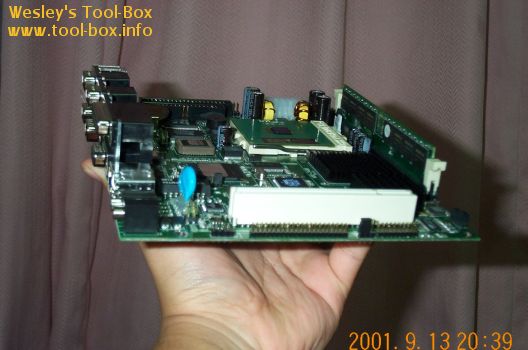
The MSC-740B motherboard looked really spiffy, and I could stare at it all day, but I needed to move on so I could do some initial tests to examine the board's characteristics. On the specification sheet, it said:
- CPU: FC-PGA Pentium III and Celeron up to 1GHz
- Chipset: Intel 440BX Chipset
- Memory: One DIMM Socket for SDRAM up to 256MB
- Video: Trident BladeXP with 16MB RAM (3D and DVD Support)
- Storage: One EIDE Channel (UDMA/33), One Floppy Interface
- Ports: 2 USB, 1 Parallel, 4 Serial (yes, four.. it is evident in the picture)
- Input: PS/2 Mouse and Keyboard
- Display: D-Sub 15pin Analog & TTL/LVDS Digital (for LCD Panel)
- Network: Realtek RTL8139C (10/100Base-Tx)
- Sound: Crystal CS4281 PCI Sound Interface
So the motherboard wasn't so lagging behind in technological aspects that much, which was more than I could ask for since it this board was designed for industrial use. I got myself an Intel Pentium III 933MHz CPU and a KingMax PC133 256MB SDRAM. I chose KingMax primarily because of the height limit I was setting for this project; the whole thing must not exceed 4cm including the casing. Since a regular DIMM module already gets close to the limit itself, the KingMax's low-profile (2.5cm) DIMM design was the only choice. The Pentium III part was a bit of a disappointment for me, being a big supporter of AMD chips. But in this corner of motherboard industry, Athlon wasn't being considered at all for a motherboard design yet, and so I had to settle with a Pentium III. The upside was that the performance / power-consumption ratio of a Pentium III is great, and less heat would be generated, which should provide more design headroom.
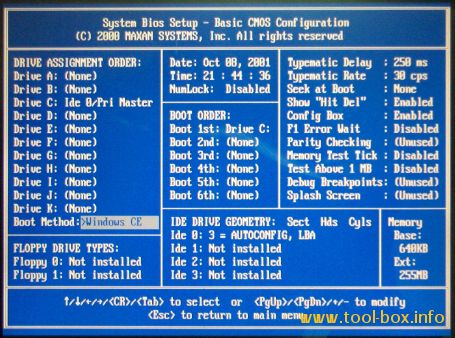
I plugged these in and confirmed that the motherboard functioned correctly, but I noticed that something looked very wrong. The BIOS setup screen was not the usual Award / Phoenix BIOS that most of us got used to. The designers of this motherboard picked a General Software BIOS instead, apparently because of its industrial nature. Not only do you have a choice of assigning a physical drive to a drive letter, you can determine the boot order very liberally. And notice the Boot Method part: you have the option of running Windows CE! You don't see this kind of option every day. However, it did have the downside of apparently not supporting CD-ROM booting. Also, Maxan never designed this motherboard to be tweaked, and the BIOS, as well as the on-board jumpers had no performance tweaking option at all. A sort of 'tweaker's nightmare', so to speak. I'll get to this aspect later on.